
Route plannerESEN

Salinas

Afro-Ecuadorian culture, bomba and salt in the Chota Valley

1 route

Routes that ran through

Stop

Terminus of the Freedom Train

1.640 m

Altitude

Imbabura

Province

Salinas station

The Salinas station is the terminus of the Freedom Train, in the parish of Salinas (Imbabura), at 1,640 m above sea level, in the warm Chota Valley. The journey from Ibarra descends among dry landscapes and gorges to this vibrant Afro-Ecuadorian community, of deep roots and enormous cultural richness.

Salinas is the birthplace of bomba music, an Afro-Choteño rhythm danced with a bottle balanced on the head, and preserves its salt heritage in the Salt Museum, which tells the story of salt extraction by the Black communities. The Afro cuisine, with pigeon peas, beans and sweets, completes a unique experience that blends train, history and living culture.
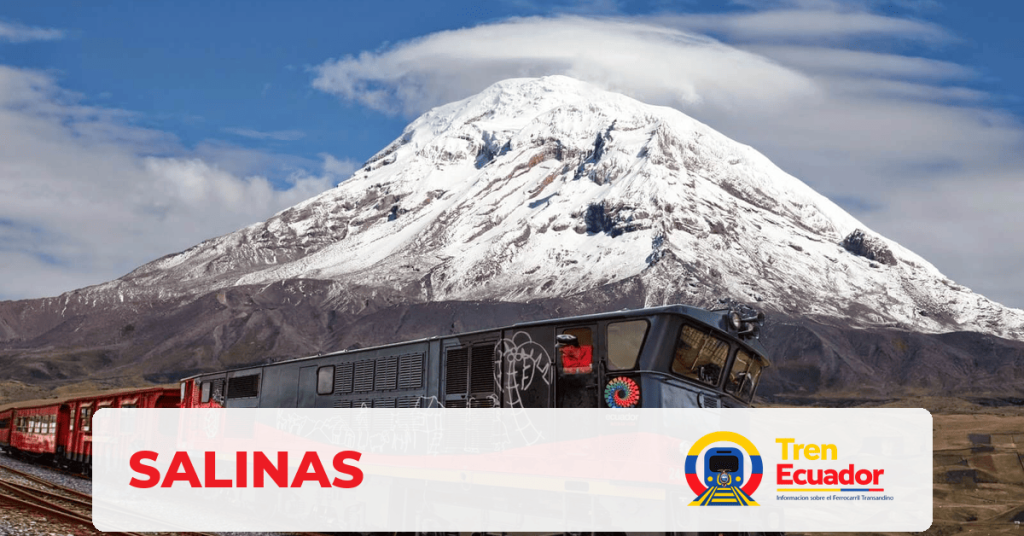
Estación de tren de Salinas, Ferrocarril Transandino del Ecuador
Salinas stationSalinas (de Ibarra), Imbabura · 1,640 m a.s.l.
Altitude1.640 m
RoutesFreedom Train
PositionTerminus of the Freedom Train
Coordinates0.4990° N, 78.1330° W

Where is Salinas station?

Salinas station is located in Salinas (de Ibarra), Imbabura. Coordinates: 0.4990° N, 78.1330° W.

What to see and do nearby

Points of interest a short distance from Salinas.

Salt MuseumHistory of salt extraction by the Afro-Choteño community.Salinas centre
Bomba musicAfro-Ecuadorian rhythm and dance, the identity of the Chota Valley.Salinas
Chota ValleyWarm, dry valley of strong Afro-Ecuadorian culture.Surroundings
Afro cuisinePigeon peas, beans and traditional sweets of the community.Centre
Old railway salt worksMemory of the train tied to the salt trade.At the station
Valley trailsHikes among arid landscapes and lookouts.Surroundings

Other stations on the Freedom Train (Tren de la Libertad)

Freedom Train (Tren de la Libertad)

IbarraTerminalMain
SalinasTerminal

Station facilities

The stations of the Trans-Andean Railway preserve their historic architecture, with a ticket office, waiting room and platform. Here is what you will find at this station.

Historic ticket office and ticket sales
Waiting room and restrooms
Platform for boarding the train
Space for luggage and bags
Train route and schedule information
Food and craft stalls nearby
Taxis and public transport at the exit
Heritage station — a great spot for photos

Connections from Salinas

Freedom Train (Tren de la Libertad) — Ibarra ↔ Salinas (Imbabura) · partly running (municipal segment). Days: Historically Wednesday to Sunday and public holidays.

Getting there. Salinas is linked by road to nearby towns; outside the station you will find taxis and public transport.

Plan your journey — use our route planner to see which route connects Salinas with other stations.

Please note. Ecuador's national railway service has been suspended since 2020 (Ferrocarriles del Ecuador, FEEP, in liquidation). In 2025 two segments were restarted under municipal management: the Devil's Nose (Alausí–Sibambe) and Ibarra–Andrade Marín. The other routes, schedules and fares on this site are historical, for information and heritage purposes and subject to change. Always confirm availability before planning a trip.
🔖

Bookmark this Trans-Andean Railway guide

We update trenecuador.org as soon as there is news: route reopenings, schedules and fares for the segments still running, and updates on Ecuador's railway heritage. Save it and come back before planning your train trip.

Frequently asked questions

It is an Afro-Ecuadorian community of the Chota Valley, the birthplace of bomba music and home to a singular Salt Museum.
It was the terminus of the Freedom Train, which descended from Ibarra to the Chota Valley.
No. The Ibarra–Salinas route has been suspended since 2020. The active municipal section only covers Ibarra–Andrade Marín. The town is reached by road.
The Freedom Train (Tren de la Libertad) ran through this station. Check the days and prices on the schedule and fares pages.
The national service has been suspended since 2020. Only the Devil’s Nose (Alausí–Sibambe) is currently confirmed to be running. The information on this page is historical and heritage-related.

Índice de contenidos